Emergency dental treatment, please WhatsApp +852 6628 8780 Or contact our clinics




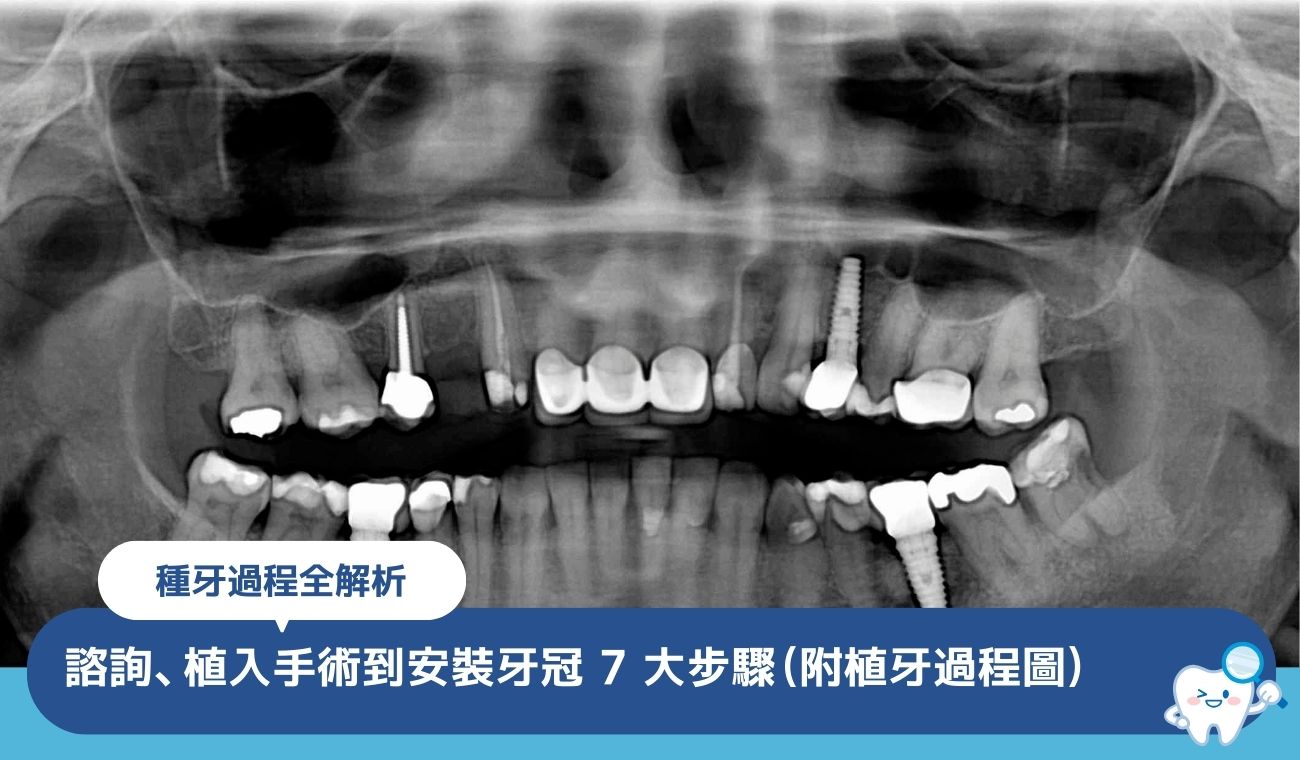
The dental implant process includes pre-operative assessment, pre-operative preparation, implant surgery, osseointegration, impression, and crown installation. After the treatment is completed, regular follow-ups and cleanings are required to ensure the stability of the implant and oral health.
How long does the dental implant process take? Overview of 4 Common Implant Process Durations
The duration of dental implants depends on the condition of the jawbone and the chosen surgical method. To give you a better idea, we have compiled a comparison table of the durations for four common dental implant processes:
| Dental Implant Methods | Suitable Candidates | Required Time (Estimated) | Features |
| Traditional Dental Implant | Those with average jawbone conditions | About 4-8 months | Conducted in stages (first tooth extraction), waiting about 1-2 months for bone healing, followed by the implant surgery. |
| Minimally Invasive Dental Implant | Those with sufficient jawbone volume | About 3-6 months | Small wounds, short surgery time, low pain sensation, quick recovery. |
| Immediate Extraction and Implantation | Those without inflammation around the tooth root and with sufficient jawbone volume | About 3-6 months | The implant is placed on the same day as the tooth extraction, eliminating one surgical wound and several months of waiting. |
| Bone Grafting Followed by Dental Implant | Bone atrophy and insufficient bone mass | About 6-12 months | Bone graft surgery must be performed first, waiting about 3-6 months to stabilize the foundation, and then proceed with the implantation surgery. |
Dental implant process diagram
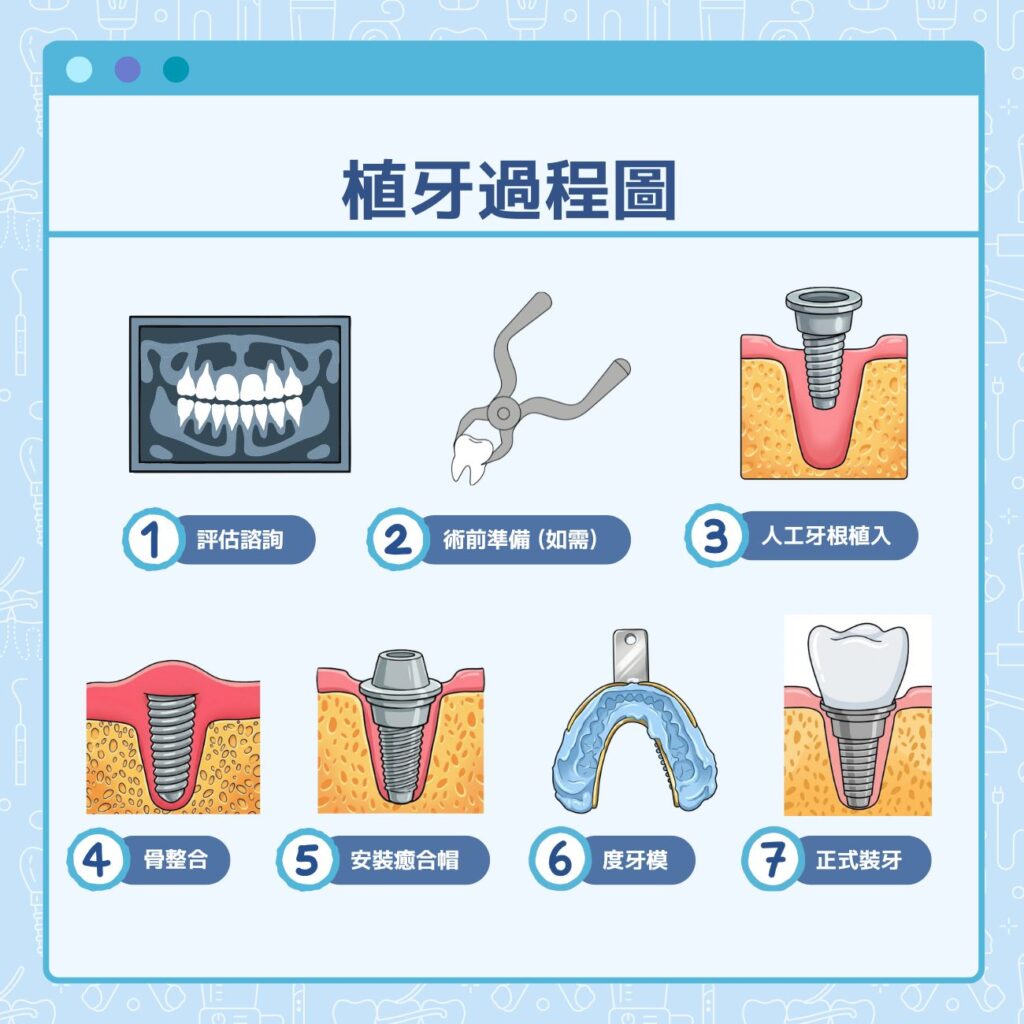
Implant process 1: Initial assessment and 3D computer scan
Before the implant, the dentist will assess oral health, including periodontal condition, bone mass, and a full mouth examination. In addition to visual inspection, a 3D computer scanwill be used to measure bone quality, gum thickness, and nerve position, providing complete reference information for the subsequent implant surgery.
Implant process 2: Various preoperative preparations (such as tooth extraction, bone grafting)
If there are remaining roots that need to be removed or if there is inflammation in the periodontal area, these must be addressed at this stage. A wound recovery period of 1-2 months is required before continuing to the next stage of treatment.
For patients with more severe bone loss, the doctor will recommend performing "bone graft surgery" to fill in bone powder to guide bone regeneration. Bone grafting can increase bone mass to support the implant, and the recovery period usually takes 3-6 months, but a solid foundation is necessary to ensure the longevity of the implant.
Implant process 3: Implant placement surgery
On the day of the surgery, the doctor will implant the titanium implant (artificial tooth root) into the alveolar bone under local anesthesia.
The entire process usually takes 60-90 minutes (for a single tooth). Because of the assistance of anesthesia, the discomfort during the surgery is actually quite minimal. Based on our experience and patient feedback, it feels similar to the vibration sensation during a dental filling.
Additionally, for patients who have immediate extraction and implantation, the steps of extraction and bone grafting mentioned above will be skipped, directly entering the surgical phase, completing both extraction and implant placement procedures on the same day.
Implant process 4: Bone integration waiting period (about 3-6 months)
After the implant is placed, the artificial root and jawbone need some time to bond tightly, a stage known as "osseointegration."
Generally, the lower jaw takes about 3 months, while the upper jaw, due to softer bone quality, may take 4-6 months. During this period, it is necessary to maintain good oral hygiene and follow the doctor's advice for regular check-ups to monitor the condition.
Dental implant process 5: Installing the gingival former (also known as abutment or healing cap)
Once the dentist confirms that the implant is securely placed in the jawbone, the treatment will enter the second phase.
The doctor will make a small incision in the gum covering the implant and install the "healing cap" or "gingival former."
The purpose of this small component is to guide the shaping of the gum, allowing for a beautiful gum line around the future crown that looks as natural as real teeth, while also preparing for the installation of the prosthesis.
Dental implant process 6: Impression
After the gum line is shaped (usually about 1-2 weeks), an impression will be taken.The impression (dental mold)。
This step is to record the occlusal position of the mouth, ensuring that the subsequent prosthesis fits perfectly with the oral structure. The accuracy of the impression will directly affect the final occlusal effect and comfort of the teeth.
Dental implant process 7: Official tooth installation and regular follow-up
The dentist will fix the completed crown onto the implant abutment using precisely designed screws and adhesives. After securing it, the doctor will carefully check the overall occlusion and comfort in the mouth, and if any occlusal discomfort is found, adjustments will be made immediately to ensure the prosthesis fully meets the oral conditions. The dental implant procedure is considered complete only after confirming everything is correct.
Even after the procedure is completed, subsequent dental maintenance should not be neglected. Regular dental cleanings and check-ups every six months are essential maintenance measures to maintain the stability of the implant and oral health.
Other dental implant surgical processes
Immediate extraction and implantation: implanting the implant on the same day
This procedure combines "tooth extraction" and "implantation" in one surgery, suitable for patients without severe inflammation around the tooth root:
- Preoperative assessment and imaging examination (CT scan)
- Debridement and implantation of the artificial root
- Wound healing period (osseointegration takes about 3-6 months)
- Installing the gingival former
- Impression making
- Dental crown or denture device completed
One-day implant: Installation of temporary crown
This treatment is specially developed for patients who urgently need teeth on the day of surgery (or within 24 hours):
- Preoperative assessment and imaging examination (CT scan)
- Impression (pre-made temporary dentures)
- Debridement and implantation of the artificial root
- Temporary dentures are installed on the day of surgery
- Wound healing period (osseointegration takes about 3-6 months)
- Impression making (for making formal dentures)
- Dental crown or denture device completed
Frequently Asked Questions
How many follow-up visits are needed for the entire implant procedure?
From consultation to completion, it takes about 5-8 timesof follow-up visits. The number may vary depending on whether bone grafting is needed and the healing progress.
Will the implant surgery process be painful?
The surgery is performed underlocal anesthesiathroughout, and during the process, you will only feel pressure and vibration from the instruments, without sharp pain. However, after the anesthesia wears off, there may be slight swelling or pain at the wound, but it usually alleviates within 1-3 days with the painkillers prescribed by the doctor.
Does the implant process require general anesthesia throughout? Or is local anesthesia sufficient?
Most implant surgeries uselocal anesthesialocal anesthesia, which is sufficient. Unless the patient has extreme fear of dental work or requires extensive surgery, we would recommend considering general anesthesia (sedation treatment) to allow the patient to complete the surgery in a relaxed, light sleep state.
If bone grafting is needed, how much longer will the recovery time be?
The overall treatment will usually be extended. 3-6 monthsIt varies; during this period, the gums and bones gradually integrate, providing a stable foundation for the implant.
What to do during the postoperative "edentulous period"? Can temporary dentures be worn?
If it is in the aesthetic area such as the front teeth, consider wearing temporary dentures during the transition period to maintain appearance and chewing function. However, when using temporary dentures, it is still necessary to avoid excessive chewing of hard objects.
Conclusion
The dental implant process, from oral examination, implant placement to bone integration and crown installation, is a long medical journey. It requires not only careful planning by the dentist but also the patient's patient cooperation to lay a solid foundation for dental reconstruction. I hope this article helps you eliminate doubts, feel at ease to start treatment, and regain strong chewing function and aesthetic confidence!
Extended reading: 《Complete Guide to Dental Implants: Understand the implant process, principles, advantages and disadvantages, prices in Hong Kong, and precautions in one article》
Disclaimer
This article is for informational purposes only and does not contain any invitation or solicitation. Patients should seek professional diagnosis and treatment for their conditions. For further information or to make an appointment, it is advisable to contact the relevant clinic directly. Please take care in choosing the right dental service and clinic.